Guides
Do I need an arborist report?
Most Melbourne homeowners need an arborist report when council requires one for tree removal, pruning of a protected tree, or building works near existing trees. The report type depends on the situation: a council permit report for removal or pruning, an impact assessment for construction near trees, or a health and safety assessment for a tree you are worried about.
Which report matches your situation?
Different situations call for different report types. The table below maps common scenarios to the report Arbor Analytics would prepare. If your situation does not fit neatly, request a quote and we will confirm the scope.
| Your situation | Report type | When council typically requires it |
|---|---|---|
| Removing a protected tree | Council permit report (removal) | Tree meets canopy tree or overlay thresholds, or local law applies |
| Pruning a protected tree | Council permit report (pruning) | Pruning work on a tree protected by overlay, local law, or planning permit condition |
| Building, extending, demolishing or excavating near trees | Impact assessment | Development works encroach on the root zone of a retained tree |
| Tree looks unsafe, damaged, or structurally compromised | Tree health and safety assessment | Not always required by council, but recommended before acting on a suspected hazard |
Some projects also need a preliminary assessment before detailed design, or a Tree Protection Specification and Plan for construction near retained trees. These are separate deliverables, not substitutes for a permit report.
Choose your report
Select the closest match below to view that service, or request a quote if your situation does not fit a single option.
Removing a protected tree
Council needs evidence of tree condition, photos and arboricultural justification before approving removal of a protected tree.
View optionPruning a protected tree
The tree is staying, but pruning work needs council approval or supporting arborist documentation.
View optionBuilding near trees
Extensions, pools, driveways, demolition, excavation or other development works near retained trees.
View optionWorried a tree is unsafe
Visible defects, dead branches, fungal growth, leaning, storm damage or other safety concerns.
View optionNot sure yet
Send the address, council request, photos, plans or a short description and we can confirm the right report.
View optionClause 52.17 and Clause 52.37: when a permit is required
Two state-level planning clauses protect trees across many Melbourne municipalities. Whether you need a permit, and therefore an arborist report, depends on the tree's size, position, vegetation type and the planning controls that apply to the property.
Clause 52.37: canopy tree controls
Under the Melbourne Planning Scheme, an existing canopy tree is a tree that has both (Clause 52.37-1, as amended by VC315 on 23 September 2026):
- A height of at least 5 metres above ground level
- An average canopy diameter of at least 4 metres, measured between the widest points of the drip line in two perpendicular directions
Earlier summaries of the clause, including the previous version of this guide, also described a trunk circumference test. The current definition does not include one, so check the clause itself rather than relying on a summary.
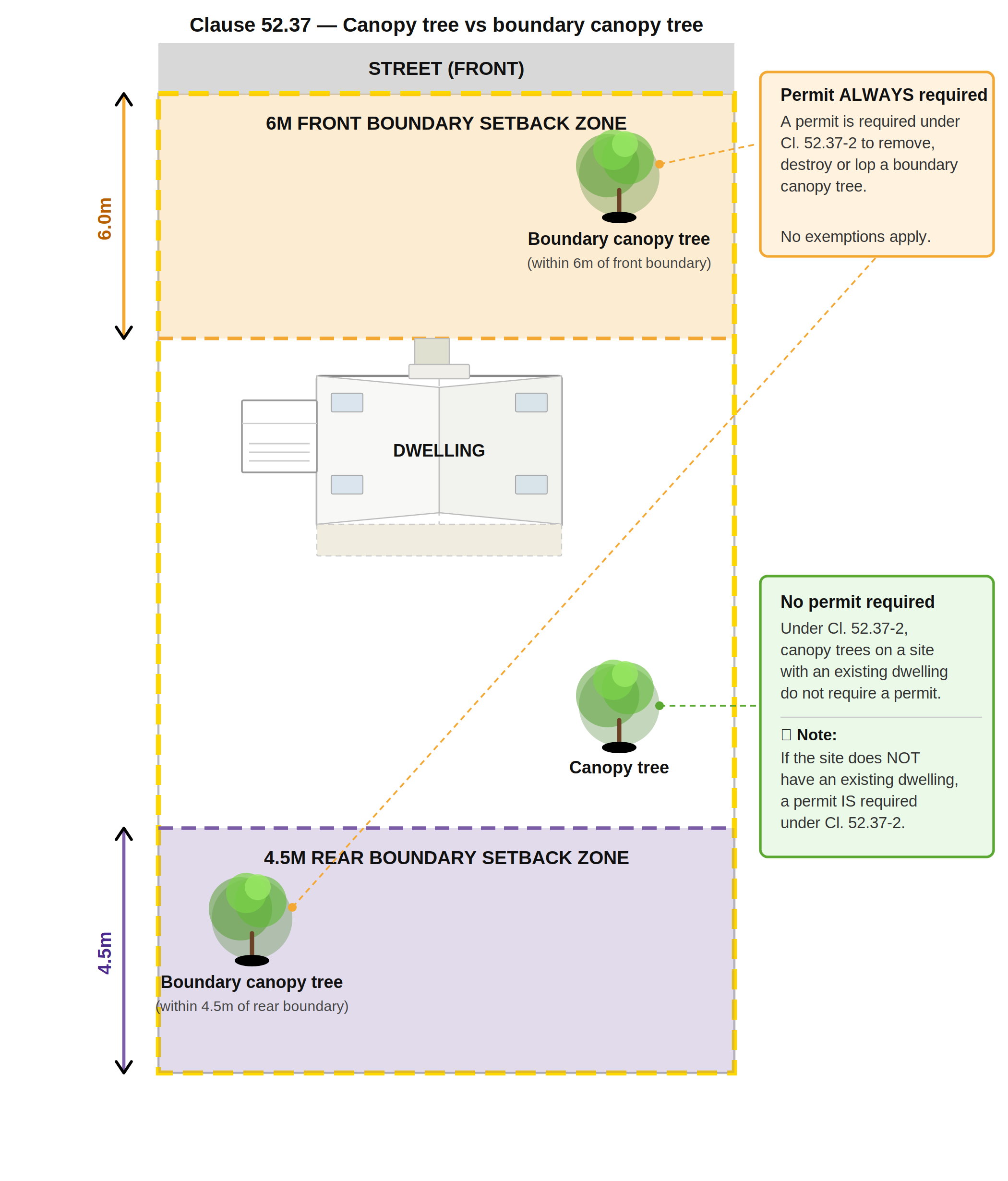
Clause 52.37-2 requires a permit to remove, destroy or lop an existing canopy tree in the Mixed Use, Township, Residential Growth, General Residential, Neighbourhood Residential, and Housing Choice and Transport zones. If any part of the trunk sits within 6 metres of the narrowest street frontage or 4.5 metres of the rear boundary, the tree is a boundary canopy tree. The exemption for a site developed with an existing dwelling applies to a canopy tree but not to a boundary canopy tree. The clause's own table of exemptions (52.37-8) also covers, among others, dead canopy trees, emergency works, noxious or environmental weeds and maintenance pruning of no more than one third of the foliage, subject to the conditions in the clause.
Clause 52.17: native vegetation
Clause 52.17-1 requires a permit to remove, destroy or lop native vegetation, including dead native vegetation, unless an exemption in the clause or its schedule applies, and Clause 52.17-5 requires the biodiversity impact to be offset where a permit is required (Clause 52.17, Melbourne Planning Scheme). Where native vegetation is affected, an arborist report or vegetation assessment supports the permit application and offset requirements.
Vegetation Protection Overlays and local laws
Many councils apply additional protections through Vegetation Protection Overlays (VPO), Environmental Significance Overlays (ESO) or local laws. These may protect trees that do not meet the canopy tree thresholds. Check the controls on your property using VicPlan or your council's planning department.
What to send with a quote request
The more information you provide upfront, the faster we can confirm the scope and provide a fixed-price quote. Here is what helps:
- Property address so we can check the planning controls and overlays
- What prompted the enquiry: a council letter, a planning permit condition, development plans, or a safety concern
- Photos of the tree or trees (a wide shot showing the full canopy and a closer shot of any visible issues)
- Any council correspondence such as a request for further information, planning conditions, or a notice
- Development plans or drawings if you are building near trees
- Approximate number of trees involved (a rough count is fine)
You do not need all of these to get started. If you are not sure which report you need, tell us what is happening and we will confirm the right scope. See what affects an arborist report's cost for more on how scope and pricing work.
How to check your property's controls
Each council area may have additional tree protection overlays or local laws beyond the statewide clauses. You can check the planning controls that apply to your property using these resources:
Frequently asked questions
What does an arborist report include?
An arborist report typically includes a site inspection, tree species identification, condition assessment, measurements, photos, analysis against relevant planning controls and Australian Standards, and written recommendations. The exact content depends on whether the report is for removal, pruning, development or safety purposes.
Can I use one report for multiple trees?
Yes. A single arborist report can cover multiple trees on the same property. The scope, and therefore the cost, increases with the number of trees, but you do not need a separate report for each one.
How long is an arborist report valid for?
There is no fixed expiry set by Victorian planning law. However, council may request an updated report if conditions have changed since the original assessment, such as after storm damage, new construction, or a significant period of time. Check with your council if you are unsure whether an existing report is still accepted.
What this guide does not cover
This guide summarises two statewide clauses of the Victorian planning schemes. It does not list each council's local law thresholds or overlay schedules, which can protect smaller trees, and it does not cover trees on council land or road reserves. It is general information, not advice about a particular tree or application; the controls that apply to your property decide whether a permit and report are needed.
Sources
- Melbourne Planning Scheme, Clause 52.37 Canopy trees (introduced by VC289 on 14 September 2025; definitions, permit requirement and exemptions amended by VC315 on 23 September 2026; accessed 29 September 2026)
- Melbourne Planning Scheme, Clause 52.17 Native vegetation (accessed 29 September 2026)
- VicPlan, Victorian Government planning map for zones and overlays (accessed 29 September 2026)
Get help choosing the right report
If you are unsure whether your tree or project requires a report, Arbor Analytics can help. Send us the property address, what is happening, and any council correspondence. We will confirm the report type and scope, then provide a fixed-price quote before work starts.
Get a quote